
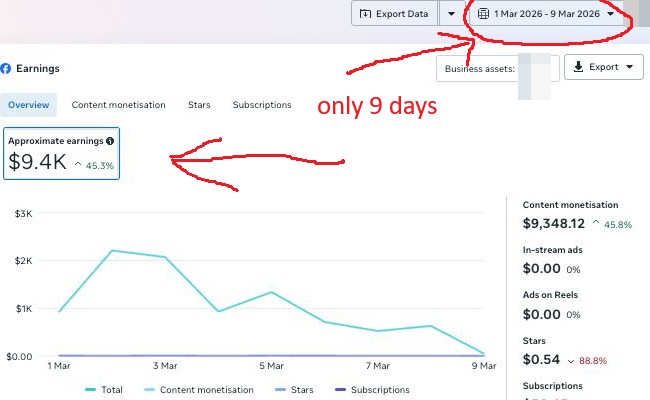
Ready to Turn Your Page Into a Full-Time Income?
That screenshot shows $9,400 earned in 9 days by a real page in our partner program using Facebook Content Monetization. We join as a 50/50 partner — handling strategy, setup, and scaling while you keep running your page. Submit your page link and we will tell you if it qualifies.
Your Page Isn't Eligible Yet — But You're Closer Than You Think
Thanks for applying for the 50/50 partnership. Your page doesn't meet the requirements right now, but with the right system you can close the gap faster than you'd expect.
Facebook Monetization Suite
The complete toolkit: automation, content systems, and a proven strategy to take your page from where it is to fully monetized.
Show Me the Suite →Facebook Elite Consulting
For serious publishers who want expert eyes on their page and a tailored plan to scale toward $30K+ months.
Talk to an Expert →Hit the requirements later? Come back and re-apply anytime.
Facebook Marketplace Calculator — Reseller Profit & Pricing
Before you buy inventory to flip on Facebook Marketplace, knowing your numbers prevents costly mistakes. This calculator figures out your exact profit, margin, and suggested sell price for both local pickup and shipped listings. Enter your buy price, quantity, target margin, and shipping costs to get a full profitability breakdown and the minimum price you need to hit your goal.
Frequently Asked Questions
Is reselling on Facebook Marketplace profitable?
Yes, especially for local pickup items where there are zero platform fees. The most profitable Marketplace resellers focus on specific categories they understand well — furniture, power tools, gym equipment, and electronics are perennial top performers. Sourcing from estate sales, auctions, and garage sales at steep discounts and reselling at market rate creates strong margins without requiring specialized skills.
How do I calculate my break-even sell price on Marketplace?
For local pickup: break-even sell price equals your buy price plus any prep or cleaning costs. For shipped items: divide your total cost (buy price plus shipping) by 0.95 to account for the 5% Marketplace fee. For example, if an item costs $20 and shipping is $8, your minimum shipped sell price to break even is ($20 + $8) / 0.95 = $29.47. Pricing below this means losing money on every sale.
Is local pickup or shipping more profitable on Marketplace?
Local pickup is more profitable per transaction because there are no platform fees. A $50 local sale nets you $50; a $50 shipped sale nets you $47.50 after the 5% fee. Additionally, shipping introduces packing costs, carrier rate risk, and the potential for buyer disputes over item condition. Use shipping for niche or high-value items where local buyer pools are too small to move inventory quickly.
What item categories sell best on Facebook Marketplace?
Furniture, especially sofas, dining sets, and dressers, sells quickly because it is hard to ship and buyers want to inspect it locally. Power tools, gym equipment, outdoor furniture, and gaming consoles also move reliably. Seasonal items (lawn mowers in spring, snow blowers in fall, holiday decor) can generate excellent margins when listed at the right time. Brand-name clothing in good condition and children's furniture and gear are consistently high-demand categories.
How does pricing psychology affect Marketplace sales?
Price slightly below round numbers — $47 sells faster than $50. List higher than your true minimum to allow room for negotiation, since most buyers will send an offer. Research active and recently sold listings for comparable items to calibrate your price point. Items priced 10-15% below the typical listing price for their condition generally sell in days rather than weeks, improving your inventory turnover rate.
How do I scale a Marketplace reselling operation?
Scaling requires systemizing your sourcing, evaluation, storage, photography, and delivery processes. Identify reliable sourcing venues and visit them consistently. Develop a rapid assessment process based on known margins in your 2-4 core categories. Set up a dedicated photo station for consistent listing images. As volume grows, consider a helper for transportation. Most successful resellers reach $2,000-5,000/month within a year by specializing rather than buying anything that might sell.
Profit Formula
Net profit = gross revenue minus all costs. Costs include: item buy price, shipping paid to send the item, and Facebook's selling fee (for shipped listings). Margin = net profit divided by gross revenue, expressed as a percentage. A 40% margin means you keep $0.40 of every $1.00 in revenue after all costs. Calculate your margin before buying, not after, to avoid unprofitable purchases.
Fee Structure
Local pickup listings: zero Facebook fees. Shipped listings: 5% of the sale price with a $0.40 minimum. A $10 shipped item costs you $0.50 in fees (5%). A $5 shipped item would normally be $0.25 at 5% but the minimum kicks in at $0.40, making the effective rate 8%. Price accordingly for very low-value shipped items to ensure you still reach your target margin after the minimum fee.
Shipping Strategy
For shipped sales, choose the right carrier based on item weight and size. USPS is cheapest for items under 1 lb. UPS and FedEx Ground are competitive for 2-50 lb packages. For large items over 70 lbs, freight quotes are needed. Always weigh and measure items before listing if offering shipping. Underestimating shipping costs is one of the most common profit-killers in Marketplace reselling.
Scaling Tips
The fastest way to scale Marketplace profit is to specialize in 2-3 categories where you have strong knowledge of market pricing and reliable sourcing channels. Set a minimum margin threshold (e.g., 50%) and refuse to buy below it. Keep a running inventory spreadsheet to track buy prices, listed prices, and days-on-market. Items that sit for 30 days should be repriced down to free up capital for faster-moving inventory.
More Free Tools
Computer Virus Name Generator
Generate realistic fake malware names in antivirus naming conventions with threat profiles and severity ratings.
AI Data Licensing Readiness Checker
Answer 10 questions to score how ready your company data is for an AI data licensing deal.
Robots.txt Viewer
Enter any domain to view its robots.txt and see which pages are blocked from Google.
Key Person Risk Calculator
Find your business bus factor and the critical tasks that depend on a single person.