
Ready to Turn Your Page Into a Full-Time Income?
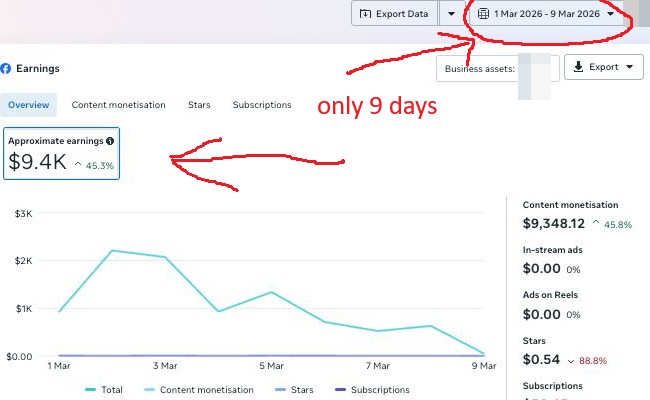
That screenshot shows $9,400 earned in 9 days by a real page in our partner program using Facebook Content Monetization. We join as a 50/50 partner — handling strategy, setup, and scaling while you keep running your page. Submit your page link and we will tell you if it qualifies.
Your Page Isn't Eligible Yet — But You're Closer Than You Think
Thanks for applying for the 50/50 partnership. Your page doesn't meet the requirements right now, but with the right system you can close the gap faster than you'd expect.
Facebook Monetization Suite
The complete toolkit: automation, content systems, and a proven strategy to take your page from where it is to fully monetized.
Show Me the Suite →Facebook Elite Consulting
For serious publishers who want expert eyes on their page and a tailored plan to scale toward $30K+ months.
Talk to an Expert →Hit the requirements later? Come back and re-apply anytime.
Facebook Page RPM Calculator — Revenue Per 1,000 Views
RPM is the single most important metric for understanding your Facebook video earnings efficiency. This tool offers three calculation modes: calculate your actual RPM from real earnings data, project future revenue at different view counts and growth rates, or find the RPM needed to hit a specific income goal. Switch between modes to get the exact insight you need.
Frequently Asked Questions
What is the difference between RPM and CPM on Facebook?
CPM is what advertisers pay per 1,000 ad impressions — it is an advertiser metric. RPM is what you as a creator receive per 1,000 video views — it is a creator metric. RPM is always lower than CPM because Facebook retains a percentage of advertiser spend. Additionally, not every view generates an ad, so RPM accounts for the ratio of monetized views to total views. Your RPM in Creator Studio is your actual net earnings rate per 1,000 views.
What factors affect Facebook video RPM?
The biggest factors are audience geography (US audiences produce 3-5x higher RPM), content niche (finance and health attract higher advertiser bids), video length (3+ minute videos qualify for mid-roll ads which increase total ad revenue per view session), time of year (Q4 RPMs are 30-60% higher than Q1), and engagement quality (higher engagement attracts premium ad inventory).
What is a typical RPM for Facebook videos?
Typical RPM ranges: $0.10-$0.50 for international/developing market audiences; $0.50-$1.50 for mixed US/international; $1.50-$3.00 for primarily US audiences in general niches; $3.00-$8.00+ for US audiences in finance, health, and technology niches. These are averages — individual months can vary significantly based on advertiser demand fluctuations and seasonal patterns.
How do I improve my Facebook video RPM?
The most effective RPM improvements are: create English-language content on topics that attract US viewers, shift your content toward finance, health, education, or other high-CPM niches, make videos at least 3 minutes long to unlock mid-roll ad slots, post consistently to build returning viewership, and avoid content that triggers Facebook's restricted monetization labels (politics, news, sensitive topics). Each of these can meaningfully move your RPM upward over time.
Does RPM fluctuate seasonally on Facebook?
Yes, significantly. Q4 (October through December) consistently delivers the highest RPMs of the year due to holiday advertiser spending. January RPMs drop steeply as budgets reset. Q2 (April-June) shows gradual recovery. Summer (July-August) often sees a mild dip. When projecting annual earnings, account for this seasonality rather than multiplying your current monthly RPM by 12 — you will overestimate Q1 and underestimate Q4.
How do I find my actual RPM in Facebook Creator Studio?
In Creator Studio, navigate to Monetization in the left sidebar, then select the In-Stream Ads overview or Performance tab. Choose a date range and look at your total earnings and total eligible views. Divide earnings by eligible views and multiply by 1,000 to get your RPM. Some Creator Studio views show RPM directly in the reporting table. The Monetization Insights section provides more detailed breakdowns by video and time period.
RPM Definition
RPM (Revenue Per Mille) is the creator's net earnings per 1,000 total video views, including both monetized and non-monetized views. It differs from CPM (Cost Per Mille), which is the advertiser's gross cost per 1,000 ad impressions. RPM is always lower than CPM. It is the most useful metric for comparing earnings efficiency across different pages, niches, and time periods.
Niche Impact
Your content niche is one of the biggest determinants of RPM. Advertisers in finance, insurance, health, and legal services compete aggressively for high-intent audiences and pay premium CPMs. This advertiser demand flows through to creator RPMs. A finance content creator with 500,000 monthly views can earn significantly more than a general entertainment creator with 2,000,000 monthly views purely because of the RPM differential between niches.
Improving RPM
RPM improvement is a long-term strategic play. Growing your US audience share is the single highest-leverage change available to most creators. Shifting content topics toward finance, health, education, or career development increases advertiser competition for your inventory. Making longer videos with multiple mid-roll placements increases ad impressions per viewing session. All three changes compound — a US finance video with mid-roll ads can earn 5-10x the RPM of an international entertainment video of the same length.
Seasonal Variation
Q4 (October-December) is the highest-RPM quarter of the year due to holiday advertiser spending — RPMs can be 30-60% above the annual average. January RPMs drop sharply as budgets reset after the holiday spike. When planning annual earnings, budget conservatively for Q1 and Q2, moderately for Q3, and ambitiously for Q4. A content-heavy Q4 strategy maximizes earnings when CPMs are at their seasonal peak.
More Free Tools
Age Calculator
Calculate your exact age in years, months, and days plus days until your next birthday.
Flash Code Decoder
Decode LED blink sequences, BIOS beep codes, OBD-I engine fault codes, and Morse code patterns.
Screen Resolution Checker
See your screen resolution, viewport size, device pixel ratio, and display details.
Upside Down Text Generator
Flip text and emojis upside down using Unicode character substitution with a full code point breakdown.